Monday, April 14, 2014

The Art of Tourism

Our final project is actually one of the more exciting (though it will be time consuming) of the semester. I can't wait to design and print my souvenir! But I'm getting ahead of myself.

I did a bit of research on artists that utilize tourism or some aspect of tourism in their work.

The first thing I came across was a blog post from 2008 about an exhibit in Frankfurt at schirn-kunsthalle called All Inclusive:A Tourist World. The post had me intrigued.

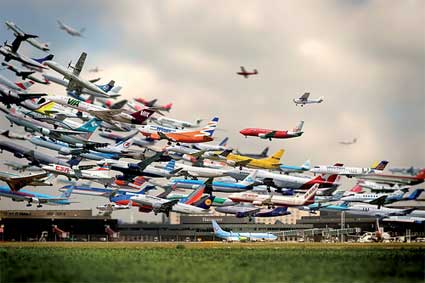
Ho-Yeol Ryu, Airport, 2005
Ho-Yeol Ryu's Flughafen is a great digital compilation of images supposedly taken at Hannover airport. I did find an interesting "debunking" of the image components from an aviation expert but the image is pretty cool nonetheless.

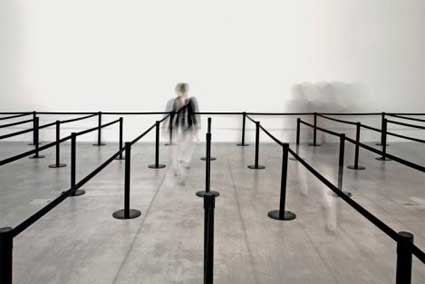
Another image featured was Crowd by Eva Grubinger.

Eva Grubinger Crowd 2007
This installation separated portions of the exhibit hall and people were forced to walk through the queue as though they were moving through a crowded area. 

NL Architects  caught my attention because their work is playful and fun. I normally can't stand architects (they are so smug - a lot like graphic designers, but that is for another post another time). Their actual architectural work isn't super awesome, but they have a series of "virtual realities" that are pretty cool. 

NL Architects Flower Power: Power Plant 2006


Saturday, April 12, 2014

Outside Event - Autodesk Gallery/3D Hubs Meetup & Mixer

For outside event #1 for the semester, my husband and I attended the 3D Hubs mixer at the Autodesk Gallery at 1 Market Street (2nd floor).

We have been working with 3D Hubs for a while now (though their print on demand system is not the most user friendly and presents problems with getting paid for work) and they had an afternoon of software presentation and a panel of speakers in the evening to celebrate their collaboration with Autodesk 123D products (essentially the Autodesk API has 3D Hubs as an integrated print source allowing users to print directly to a 3D Hubs user).

Personally I don't use most of the 123D apps because they are limited to iPad platforms (which I think does a huge disservice to the community on the whole because most of the time "makers" are big on open source (running linux homebrew machines) or PCs and a lot of designers don't use Mac products because there have been limited comprehensive design software for Mac until recently).

I do use TinkerCAD (as does my husband) for a lot of design work, which was acquired by Autodesk last year. There are a number of reasons I love TinkerCAD and when I was teaching, I was working on a curriculum to teach it to elementary school kids.

The afternoon consisted of TinkerCAD and MeshMixer presentations (TinkerCAD is a web based CAD program and MeshMixer is sculpt/paint/print program I haven't played much with but it's on my list of explorations).

We didn't attend the afternoon tutorial sessions (but we did print a bunch of swag for 3D Hubs).

Ultimately the most interesting part of the entire event was the Autodesk Gallery itself. As an artist with a background in industrial design, I feel that products can be art. The process of developing an idea is just the same as developing artistic ideas. They had an amazing range of things from 3D printed objects (and an Objet SLS printer), giant Lego sculptures, various prototypes and mock ups of vehicles and products and more. You really should check it out. They are open to the public on Wednesday and Friday each week.


Tuesday, April 1, 2014

Augmented Bodies - Project and Thoughts

First I'd like to comment on how interesting it was to discuss augmented bodies with the group and hear others thoughts on ideas and current body modifications.

A few things I found interesting was the reaction most had to the idea of men getting muscle implants or having ball bearings inserted in the penis. Most people seemed really disgusted at the idea of the modifications that men are currently undergoing, yet no one really gives a second thought to the ways that women have been "augmenting" their bodies for hundreds of years. Consider foot binding and corsets among the early ways that women augmented their bodies to fit the fashion of the period. Fast forward to the modern era and now we have breast implants, butt implants, lip implants, cheek bone implants and more. And that is just the list of augmentations in the realm of plastic surgery.

No one seems to think twice about how "gross" it is when women are inserting foreign bodies into themselves to create a more perfect appearance, yet there was much discussion about how it was lazy of men to get muscle implants instead of hitting the gym.

An interesting observation.

There was also some discussion about the appropriation of various "traditional" body modifications by the western world such as tattooing, branding, the filing of teeth, gauging of lips/ears/septum, etc. It brought up some interesting thoughts on appropriation of another culture's tradition and ceremony, but it was hard to really take a stance on is it wrong or is it right. I'm not entirely certain where I stand on the thought. I have some tattoos, most of which are related in some way to life events or rights of passage. I admit I have a few that I got "just because I could" but most of them hold deep meaning to me.

On to the assignment!

The idea I ended up working with was the idea of a parasitic relationship between humans and the earth. As the host, the earth began working to rid itself of the parasites (humans) through excretion of toxins that is triggered with the presence of a human.

Working with the idea of gene splicing and genetically modified organisms, I took the idea one step further. What if the modification of genetic material could allow "shape shifting" to be utilized as camouflage from triggering the release of toxins?


Parasite
par·a·site
ˈparəˌsīt
noun 
1. an organism that lives in or on another organism (its host) and benefits by deriving nutrients at the host's expense.
Consider the parasitic relationship between humans and the earth. Imagine a world where the Earth (host) begins working to rid itself of the humans (parasites) through excretion of toxins triggered by the presence of a human.
Working with the ideas of gene splicing and genetically modified organisms, what if these ideas were taken one step further? What if the manipulation of genetic material could allow for "shape shifting" to be utilized as camouflage from extermination/detection?
Original Image

Modified Image

Modified image placed in scene

Friday, March 14, 2014

Augmented Bodies - Brainstorming

This particular assignment is full of possibilities. Practical ideas? I could do that. But I don't really want to. Besides, many of the more practical ideas have already been illustrated or involve internal devices (thinking back to my thought pushing idea during the Vannever Bush assignment).

A few practical ideas I had included a small glow stick style unit placed just under the skin that changed colors with moods and emotions. I was thinking heavily about how much difficulty people with Aspergers (or on the autism spectrum) have reading people's facial expressions and understanding emotions. A small indicator would allow for a cue to be visualized based on color instead of trying to differentiate minute facial cues.

Great idea, but sort of a boring augmentation to illustrate.

I started thinking about parasites and parasitism. Parasitism is a non-mutual symbiotic relationship that doesn't result does NOT kill the host. I found out that a parasitoid is an insect that produces larvae that eventually kill their host.

I started thinking about how humans sort of have a parasitoid relationship with the Earth. We're here. We don't do anything mutually beneficial for our host (the Earth). In fact, we are killing our host.

What if the Earth began killing off the parasites? I imagine a world that excretes a variety of toxins when they detect the presence of humans. Humans have taken to living in sealed environs to avoid the toxins but cannot survive forever in these sealed locations.

Humans began an attempt to hybridize themselves to evade the detection of the Earth. They have become shapes shifters, allowing them to take on characteristics of various plants and animals. These characteristics allow them to avoid detection, thereby preventing toxin excretions.


I practice yoga. A lot. I used to teach yoga to kids (most fun ever) and try to incorporate yoga into my everyday life. I started thinking about various poses and how they reflect nature.

I was really intrigued by scorpion, but I would likely need props because I don't have the arm strength I used to. Removing the props and background would be a lot of work. (not impossible, but a lot of work nonetheless). Also, a human shifting into a scorpion form would be a HUGE scorpion. Seriously huge.

I will be working with tree pose instead.
Thursday, March 13, 2014

Indeterminacy Switch

I did Vanessa's Indeterminacy project, which was to create a poem using letters scrambled from the answers to a series of questions.

The questions/answers were as follows:

Your full name: Sarah Nicole Love Kelly

Where you were born: Sacramento

Your favorite food: Strawberries

The name of your favorite song: Green and Dumb

Your astrological sign: Taurus

Your Chinese zodiac animal: Sheep

Your Mayan astrological sign Eagle.

This gave me the following numbers of letters:

a b c d e g h i k l m n o p r s t u v w y
8 2 2 2 12 2 2 2 1 5 2 4 3 1 7 6 3 3 1 1 1


This gave me a total of 70 characters  to work with. 

The directions as written weren't entirely clear as to how to use the letters, but I got clarification from Vanessa (I wasn't sure if I was to re arrange the letters or if I had to choose a word that started with each of the 70 letters). 

Here is the outcome. 


Saturday, March 8, 2014

Working with Chance - Shifted Perspective

After thinking about what we have been discussing for this class about indeterminacy and working in chance, I decided to apply it to my independent studies class as well.

In 3D printing, a lot of variables are left to chance. There is no guarantee that your print will be successful. If you print the same object 1,000 times, there are any number of things that will effect the outcome. Ambient temperature, material, hot end temperatures, computer issues, hardware issues, and more can change the outcome of your print.

Case in point:


This is an 18 gallon tote filled with failed prints (going back about a year - there are more that have been thrown away or are in other boxes as well). Some failed due to equipment failure. Some failed due to material failure. Some of them we have no clue as to why they failed. 

This box is intended to be run through a "filabot" style machine to reclaim the expended filament. Mind-2-Matter and LaserGnomes try to be as green as possible, so reclaiming spent filament is inline with our  business plans. I figured in the meantime, I could do a bit of reclamation myself. 

I spent some time digging through the box to create a sculpture from failed and discarded prints. Since we design and print a myriad of things from engineering parts to organic shapes, it was an interesting melange of components to choose from. 

We had a number of MegaFire and SlugFire shells that failed for various reasons or were made prior to additional revisions that lead to our finished retail ready products for NERF blasters.  We also had a number of failed flowers from another project that we undertook for Valentines Day. 

Obviously it's time to get a larger photo tent :)

Shifted Perspective

Shifted Perspective

Shifted Perspective